
Senegal parade AFCON trophy in Paris as legal fight over title continues
A trophy held high, a message delivered
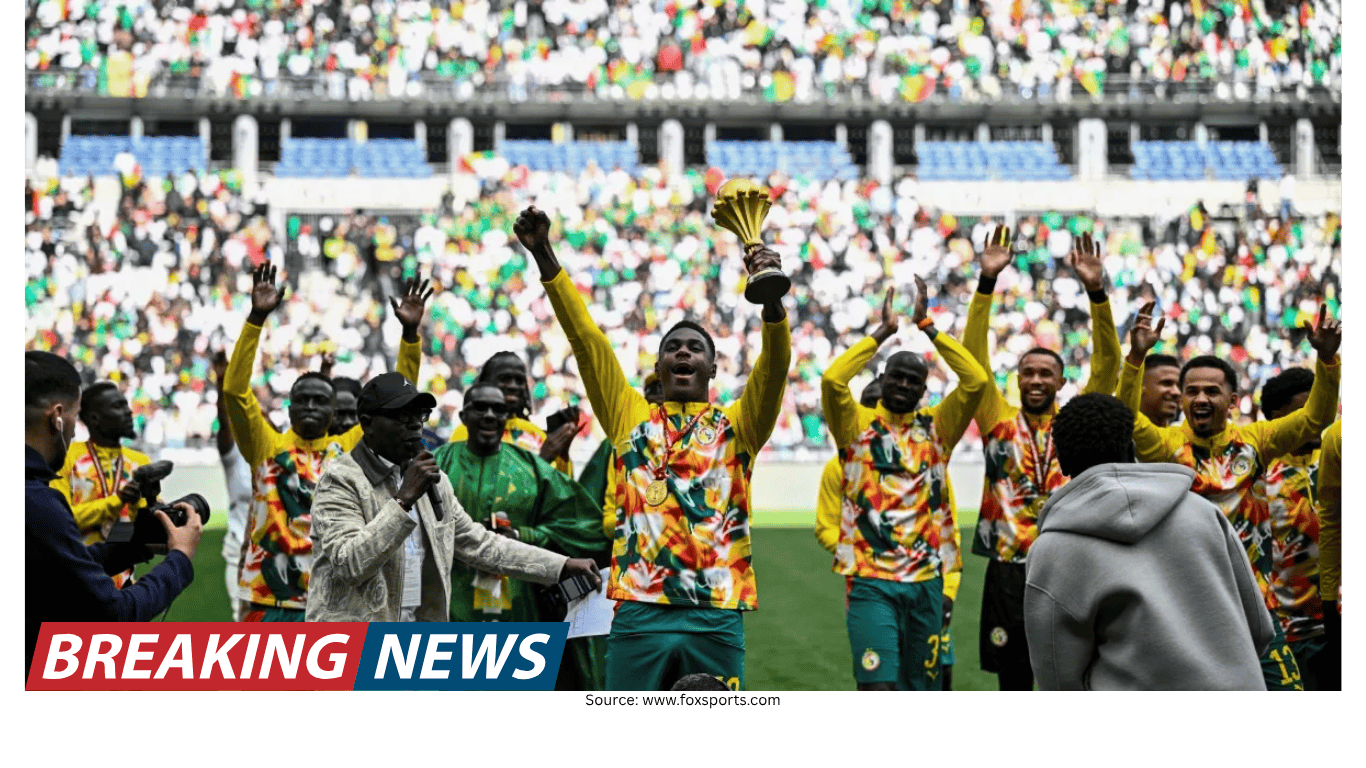
Senegal’s national team turned a pre-match ceremony in Paris into a pointed statement about identity, pride and a title now tangled in dispute. In front of a sold-out Stade de France, the Lions of Teranga paraded the Africa Cup of Nations trophy ahead of a friendly against Peru, treating the silverware not as a relic of a past triumph but as proof of a championship they still claim as their own.
The scene was unambiguous. Players and staff presented the trophy to supporters, with captain Kalidou Koulibaly leading a lap of honour. Goalkeeper Edouard Mendy held the trophy aloft as the crowd responded with loud cheers. A formal group photo followed, reinforcing the sense that Senegal’s camp wanted the public to see the team as champions regardless of what the administrative record now says.
The display came at a sensitive moment. Only 10 days earlier, the Confederation of African Football (CAF) issued a ruling that revised the official outcome of the final and removed Senegal from the top line of the tournament’s history. Senegal, which had been recognised as winning 1–0 on the pitch in January, is now operating under an official decision that declares the final a forfeit and awards the title to Morocco.
From celebration to controversy in the space of days
The dispute traces back to a dramatic final in Rabat. Senegal’s coach, Pape Thiaw, ordered his players to return to the dressing room in protest after a late refereeing decision. The flashpoint was a last-minute penalty awarded to Morocco following a VAR review for a foul on Brahim Diaz.
Senegal’s players were incensed by the decision and left the field, creating a lengthy interruption. According to the account of events, Sadio Mane played a key role in persuading teammates to return to the pitch after a 17-minute delay. The match did continue, and Senegal ultimately scored an extra-time winner through Pape Gueye after Diaz missed the penalty.
On the field, that sequence appeared to settle the matter. Yet the walk-off and the circumstances around the protest became central to how regulators later assessed the final. CAF’s intervention has since reframed the match not as a sporting contest decided in extra time but as a disciplinary and administrative case with consequences for the tournament’s official outcome.
CAF ruling: a forfeit recorded and the result changed
The CAF Appeal Board set out its justification in explicit terms, referencing the competition’s regulations. In its decision, the board stated that it was applying Article 84 of the Regulations of the CAF Africa Cup of Nations. Under that application, Senegal was declared to have forfeited the final, with the match recorded as a 3–0 result in favour of Morocco’s football federation.
That ruling does more than change a scoreline. It changes the official identity of the champion, the way the tournament is documented, and the way the final will be remembered in formal records. It also places Senegal in a rare and uncomfortable position: a team that believes it won the decisive match on the pitch but is now told that the title belongs elsewhere because of an administrative judgment.
For Senegal, the decision has been received not as a technical correction but as a profound injustice. The team’s public actions in Paris suggested that, inside the camp, the emotional and symbolic meaning of the trophy remains intact even as the official status of the title is contested.
Defiance in Paris: why the Stade de France moment mattered
Friendly matches can often feel like routine calendar dates, but Senegal’s pre-match ceremony gave the occasion a different weight. By bringing the trophy out in front of supporters and cameras, the squad effectively communicated that it does not accept the revised version of events as final.
The decision to stage a lap of honour, to have the captain lead the group, and to have the goalkeeper raise the silverware were all gestures with a shared theme: legitimacy. Senegal’s players and staff appeared determined to show that, in their view, the team remains the rightful champion of Africa.
The group photo with the trophy, in particular, carried a formal quality. It was not a spontaneous celebration but a deliberate act, as if to create an enduring image that can sit alongside the legal dispute. It also served as a message to supporters: whatever happens in administrative hearings, the squad’s sense of achievement has not been surrendered.
Senegal’s federation takes the dispute to CAS
Senegal’s response has not been limited to symbolism. The Senegalese Football Federation (FSF) has appealed to the Court of Arbitration for Sport (CAS), seeking to overturn CAF’s ruling. The FSF has branded the decision an “administrative robbery,” a phrase that captures the intensity of the federation’s rejection of the outcome.
FSF President Abdoulaye Fall is seeking reinstatement of Senegal as champions. The legal process, however, is not expected to be quick. The appeal could take months, leaving the football world in a waiting period where Senegal’s players, supporters and officials continue to assert one reality while the official record reflects another.
In the meantime, Senegal has already taken a step that indicates how it intends to frame the situation domestically and publicly. The federation has added a second star to the national team’s jerseys to mark what it describes as its contested victory. In football culture, stars carry meaning: they are shorthand for titles, a visual summary of history. Adding one while the title is under dispute is a bold statement that Senegal views its championship claim as valid and enduring.
Key events that shaped the dispute
Senegal presented the AFCON trophy to supporters at a sold-out Stade de France ahead of a friendly against Peru.
Kalidou Koulibaly led a lap of honour, while Edouard Mendy held the trophy aloft to loud cheers.
The public celebration came 10 days after CAF revised the official outcome of the final.
The final in Rabat included a protest in which Senegal’s coach ordered players to return to the dressing room following a late penalty decision awarded to Morocco after a VAR review.
Sadio Mane convinced teammates to return after a 17-minute delay; Senegal later scored an extra-time winner through Pape Gueye after Brahim Diaz missed the penalty.
CAF’s Appeal Board declared Senegal to have forfeited the final under Article 84, recording the match as 3–0 in Morocco’s favour.
The FSF appealed to CAS, calling the decision an “administrative robbery,” and has added a second star to Senegal’s jerseys.
What the controversy reveals about modern football
Even without stepping beyond the known facts of the case, the episode highlights how modern football can be shaped by forces that extend beyond the final whistle. The final itself featured VAR, a tool designed to improve decision-making but one that can also intensify disputes when the stakes are highest. The penalty decision following review became the trigger for Senegal’s protest, and the protest in turn became a central factor in the administrative ruling that followed.
The case also underscores the power of regulatory frameworks. CAF’s decision referenced a specific article of tournament regulations, and the effect of that reference was decisive: a forfeit, a recorded 3–0 result and a reallocation of the title. In other words, what happened on the pitch and what is recorded in history can diverge when governing bodies interpret and apply competition rules.
For Senegal, the response has been two-track: legal and cultural. The appeal to CAS represents the formal route, aimed at restoring the official title. The parade in Paris and the additional star on the jersey represent the cultural route, aimed at preserving a sense of victory and continuity among players and supporters while the legal process plays out.
A waiting game with reputations and records at stake
Until CAS delivers an outcome, the dispute will likely remain unresolved in the public mind. CAF’s ruling has already rewritten the official record, while Senegal’s actions suggest the team is unwilling to let that record define the story. The Stade de France ceremony, performed before a packed crowd, was a reminder that football titles are not only legal designations but also shared experiences between teams and supporters.
For Senegal’s players, parading the trophy served as a declaration of unity. It placed the squad’s collective identity at the centre of the debate, rather than allowing the controversy to be reduced to legal language alone. For supporters, it offered a moment of affirmation: the trophy was present, the team was together, and the claim to be champions was voiced through action rather than argument.
At the same time, the official stance remains clear in CAF’s published reasoning, which states that Senegal forfeited the match and that the final is recorded as a 3–0 win for Morocco. That clarity on paper is precisely what Senegal is challenging, and it is why the FSF’s appeal to CAS is so significant. It is the mechanism through which Senegal hopes to reconcile its on-field narrative with the official record.
What comes next
The timeline for the CAS process could stretch for months, leaving a prolonged period in which Senegal’s status is contested. In that interval, moments like the Paris trophy parade are likely to take on added significance. They become part of the public memory of the dispute, shaping how the story is told while the legal case moves forward.
For now, Senegal’s position is plain: the team still considers itself the rightful champion of Africa, and it is prepared to show that belief publicly. CAF’s position is equally plain: under the regulations it applied, Senegal forfeited the final and the title is recorded as Morocco’s. Between those positions lies a legal battle that will determine which version of events ultimately stands as the official history.