
Carragher analysis: How Manchester City’s midfield turned the tide against Arsenal
City’s win, and why the midfield became the headline
Manchester City’s 2-1 victory over Arsenal at the Etihad Stadium did more than deliver three points. It shifted the shape of the title race and, in Jamie Carragher’s view, offered a clear lesson in how elite matches can be decided away from the obvious moments in the penalty areas.
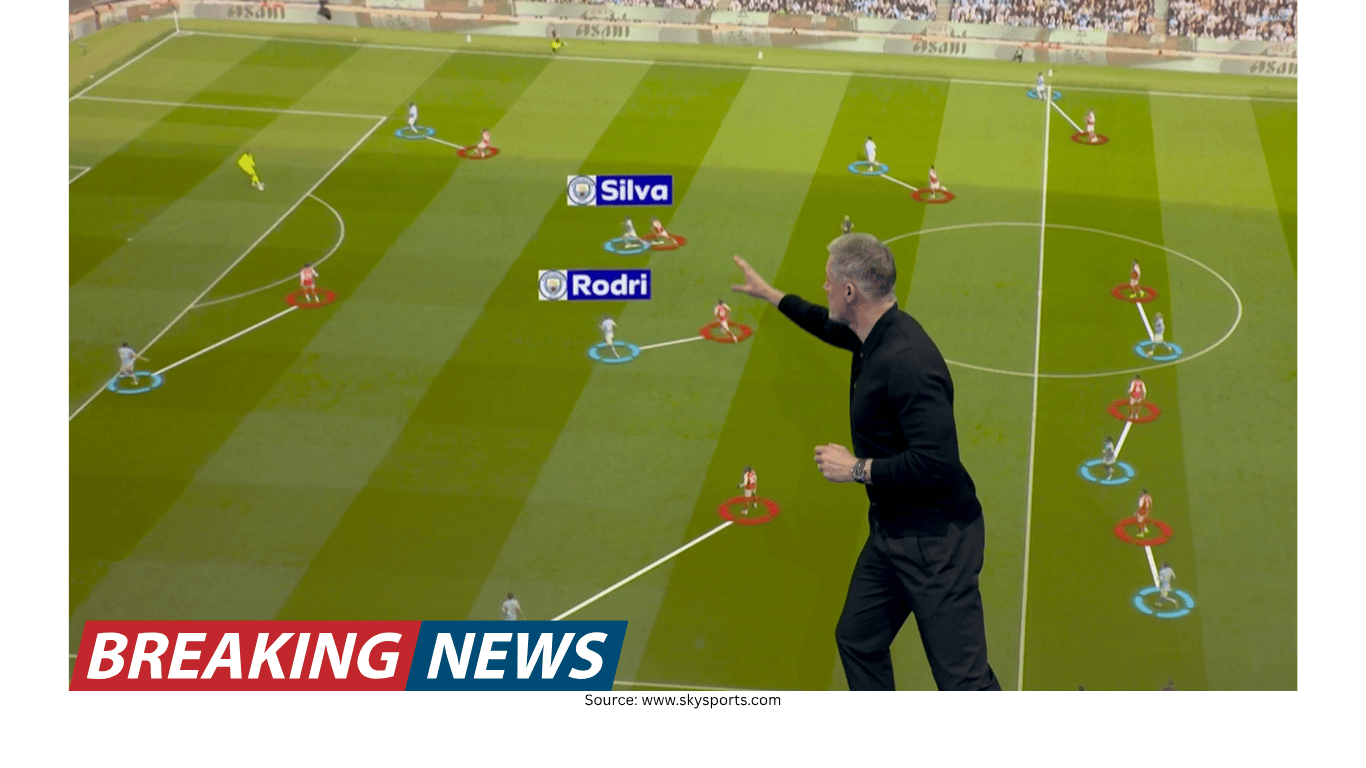
The result moved Pep Guardiola’s side to within three points of Mikel Arteta’s league leaders, with City also holding a game in hand. That context naturally draws attention to goals and key incidents, but Carragher’s assessment on Monday Night Football was that the most important battle was fought in midfield—specifically in how City’s experienced duo Rodri and Bernardo Silva handled Arsenal’s pressure and then turned it into an advantage.
In Carragher’s words, the pair delivered “one of the greatest performances as a pair” he could recall in the Premier League. The claim was not framed as a compliment for its own sake; it was presented as the foundation for why City were able to change the flow of the match after a difficult opening spell.
Arsenal’s early press: an opening 15 minutes that set the tone
Carragher began by acknowledging Arsenal’s effectiveness without the ball early on. He highlighted a striking statistic: Arsenal won possession in the final third six times inside the opening 15 minutes, the most achieved by any side in the Premier League this season.
That detail matters because it describes the problem City faced at the start. Arsenal were not simply sitting in a block and reacting; they were actively hunting the ball high up the pitch. The early pattern, as Carragher described it, saw Arsenal’s midfielders stepping aggressively towards Rodri and Silva, limiting City’s ability to feed passes into more advanced areas.
“What happened initially was Rodri and Silva had Declan Rice and (Martin) Odegaard coming right at them, so they couldn't get the ball into the players there,” Carragher said. The implication was that Arsenal’s plan was working: pressure the central outlets, disrupt City’s rhythm, and force less controlled build-up.
The adjustment: dropping deeper to escape pressure
The shift Carragher focused on was not a dramatic tactical overhaul but a decision rooted in personality and technique: Rodri and Bernardo Silva began dropping deeper to receive the ball, even to the point of appearing as part of the defensive line.
“Silva and Rodri ended up in the back four,” Carragher said. “They're the centre-backs and take the ball.” This was described as a form of problem-solving in real time. If Arsenal were going to press the midfield zone to prevent progression, City’s midfielders would move the point of reception and invite pressure in a different space.
Carragher also pointed to an early moment when Silva lost the ball under pressure from Declan Rice. Rather than discouraging City’s midfielders from taking risks, it became a test of nerve—one they passed. “We saw them lose it early on with Silva against Declan Rice. It didn't stop them from getting it again. That's real courage,” he said.
In this framing, bravery was not about tackles or duels; it was about demanding the ball again after a mistake, and doing so in the most dangerous areas of the pitch. Carragher’s view was that City’s willingness to keep receiving under pressure allowed them to start playing through Arsenal’s press rather than around it.
“They’ve seen a problem and given Arsenal a problem”
Carragher’s analysis suggested City’s midfielders did more than survive Arsenal’s approach—they inverted it. By stepping into deeper positions and continuing to receive, Rodri and Silva forced Arsenal to make decisions: continue pressing high and risk being played through, or drop off and allow City to build with control.
“Getting on the ball and being brave and then playing through that press of Arsenal,” Carragher said, was central to the momentum swing. He summarised the dynamic succinctly: “They've seen a problem and gone and given Arsenal a problem.”
This is where Carragher’s breakdown becomes less about isolated actions and more about how a match evolves. Arsenal’s early pressing success created a high-intensity start, but City’s response—particularly through midfield—changed the questions Arsenal had to answer.
Arsenal’s build-up: going long and the limits of “adventurous” play
On the other side of the midfield contest, Carragher argued Arsenal struggled to match City’s ingenuity once they had the ball. He suggested that despite familiar experience against City’s four-man press, Arsenal opted for a more direct route from goal kicks.
“There's a lot of talk about how adventurous Arsenal were. They were without the ball,” Carragher said, pushing back on narratives that might focus solely on Arsenal’s pressing and defensive work as evidence of attacking intent.
He referenced a previous meeting—described as a fixture a couple of weeks earlier in the Carabao Cup final—and argued Arsenal had already shown difficulties playing through City’s front four. In this match, he said, Arsenal adjusted their goal-kick structure with the intention of bypassing that pressure by going long.
Carragher described positional changes in Arsenal’s setup, noting that midfield players were higher than before because the plan was to avoid the first wave of City’s press. The emphasis in his analysis was that Arsenal’s solution was more about avoiding risk than embracing it.
The contrast in courage: receiving in the six-yard box
The most vivid part of Carragher’s assessment was his description of City’s midfielders receiving the ball extremely deep, even in the six-yard box, and then dribbling or passing out under pressure. For him, that was the clearest symbol of the difference between the teams on the day.
While Arsenal, in his view, were unable to play out despite having a three-man advantage, City’s midfielders were prepared to take responsibility in the most uncomfortable areas. Carragher called it “absolutely outstanding” courage to take the ball in the six-yard box “in a game of this magnitude.”
He broadened the point into a general principle: “Sometimes players don't really want the ball. That was the big difference in the game, there was courage from Manchester City with and without the ball. Arsenal didn't have it with the ball.”
In Carragher’s telling, the numbers should have favoured Arsenal in certain build-up moments. He described a situation as “7 vs 4, including your goalkeeper,” and argued that with that advantage, a team must be able to play out. His criticism was not that Arsenal lacked structure entirely, but that they lacked the willingness to execute under pressure.
Key individuals in Carragher’s frame: Rodri, Silva, and the Arsenal midfield
Carragher’s praise for City’s midfield was paired with pointed scrutiny of Arsenal’s. He specifically contrasted Rodri and Bernardo Silva’s repeated willingness to receive and recycle possession with the moments where Arsenal’s midfield did not deliver the same security.
His focus fell on Declan Rice and Martin Zubimendi as the opposing midfielders City “outsmarted.” The analysis did not present this as a simple head-to-head of talent, but as a difference in how each side dealt with pressure, positioning, and responsibility in build-up phases.
By framing the midfield as the decisive zone, Carragher effectively argued that City’s win was less about one-off moments and more about sustained control: who could keep the ball, who could escape pressure, and who could turn defensive situations into attacking platforms.
The first goal sequence: Zubimendi’s positioning and the space Cherki needed
Carragher also highlighted Zubimendi’s role in the phase of play around Cherki’s solo goal that opened the scoring for City. His point was not that Arsenal’s midfield offered no resistance, but that small differences in timing and coverage can create the marginal space a top attacker needs.
In one moment of the same phase, Carragher described Zubimendi helping the defence by moving across and “shadowing” Cherki out, with five players around the City attacker in that space. But, seconds later, in a near identical situation, Carragher said Zubimendi could not get across quickly enough, leaving Cherki with slightly more room.
“The ball comes across quickly and Zubimendi can't get over,” Carragher said. Even with four players still around Cherki, Carragher argued the loss of one defender in that immediate area created “slightly more space,” and that was enough.
The theme was consistent with the rest of his analysis: at this level, the difference between stopping an attack and conceding can be a single movement, a half-step, or the inability to cover across the pitch in time.
The second goal build-up: a turnover and the cost of a risky pass
For City’s second goal, Carragher pointed to a moment where Zubimendi gave away possession with a forward ball that ran through to goalkeeper Gianluigi Donnarumma, enabling him to start a City attack.
Carragher used this as the “flip side” of the courage he praised in Rodri and Silva. He noted Zubimendi’s pedigree—describing him as a European champion for Spain—and framed that as precisely why he was expected to handle difficult moments on the ball.
In Carragher’s words, in a title-chasing match away at Manchester City, that kind of turnover was “not good enough.” The criticism was not simply about one misplaced pass; it was about the expectation that a midfielder selected to take responsibility in possession must deliver under pressure.
Covering the right side: legs, distance, and the chain reaction
Carragher’s analysis then moved to how Arsenal’s midfield balance affected their ability to cover space. He said Zubimendi was unable to cover the right side of the pitch as Gabriel Martinelli jumped to press Marc Guehi, while Donnarumma played the ball over the winger to Nico O’Reilly.
In this sequence, Carragher suggested Rice’s preference for operating on the left of central midfield shaped the dynamic. “Declan Rice likes being on the left of central midfield. That's why he urges Zubimendi to get across,” Carragher said, before adding: “Zubimendi can't get across and he hasn't got the legs to.”
Again, the emphasis was on the physical and positional demands of elite midfield play. It is not only about passing quality; it is about covering ground quickly enough to prevent the opponent from exploiting the far side once the press is triggered.
What Carragher’s breakdown suggests about elite title-race football
Carragher’s central message was that the match was decided by how players responded to pressure, not simply by the pressure itself. Arsenal’s early press was described as highly effective and historically productive in the opening quarter-hour. But City’s response—especially through Rodri and Bernardo Silva—was to keep asking for the ball, keep receiving in deeper zones, and keep attempting to play through rather than avoid the confrontation.
In that sense, the “midfield battle” was not only about who won duels or who completed more passes. It was about who could impose their preferred way of playing when the opponent’s plan initially appeared to be working.
City’s midfielders, in Carragher’s view, solved the immediate problem and then created new problems for Arsenal. Arsenal, meanwhile, were portrayed as less comfortable when asked to show the same bravery in possession, particularly in their own build-up.
Key takeaways from Carragher’s analysis
Arsenal’s early press was highly effective, winning the ball in the final third six times in the opening 15 minutes—an unmatched figure in the league this season.
Carragher argued City “won in midfield,” praising Rodri and Bernardo Silva’s combined performance as exceptional.
A turning point in City’s control came when Rodri and Silva dropped deeper—effectively into the back line—to receive and play through Arsenal’s pressure.
Carragher framed City’s approach as a question of courage in possession, highlighting their willingness to take the ball near their own goal, even inside the six-yard box.
Arsenal, in his view, chose to go long from goal kicks to bypass City’s front four, and did not show the same comfort playing out despite numerical advantages.
He highlighted moments involving Martin Zubimendi in both City’s opening goal sequence and the build-up to the second, using them to illustrate the fine margins and the cost of turnovers and delayed coverage.
A title race tightened by a midfield lesson
With City now three points behind Arsenal and holding a game in hand, the broader story is the title race itself. But Carragher’s analysis offered a narrower, more technical explanation for why this particular game swung City’s way: the ability of Rodri and Bernardo Silva to take ownership of the ball under pressure, adjust their positioning to change the angle of the press, and keep insisting on playing through difficult moments.
In matches between leading sides, those details can be decisive. Carragher’s conclusion was clear: City’s midfield did not just compete with Arsenal’s—it shaped the match, and by doing so, helped open the run-in to what he called a “thrilling finale” to the Premier League season.