
Bayern Munich edge Real Madrid 4-3 to reach Champions League semi-finals after late drama
A quarter-final that refused to settle
Bayern Munich are through to the UEFA Champions League semi-finals after a breathless 4-3 win over Real Madrid at the Allianz Arena, sealing a 6-4 aggregate victory in a tie that swung repeatedly before being decided by late goals and a costly dismissal.
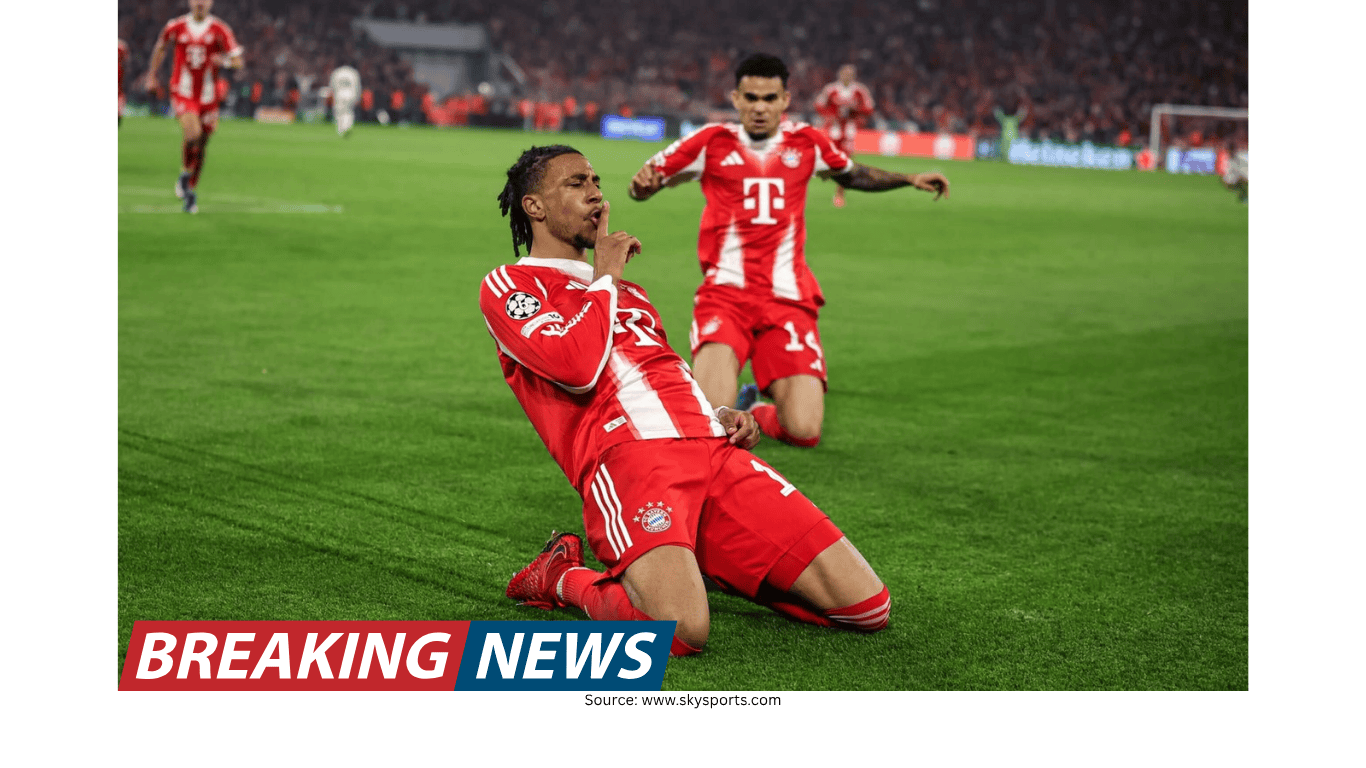
In front of a crowd of 75,000 in Munich, Real Madrid managed to take the lead three times on the night, repeatedly dragging the contest level on aggregate. Each time, Bayern found a response, and when the game appeared to be heading toward a tense finish, the final minutes delivered the decisive moments: Luis Diaz struck in the 89th minute shortly after Eduardo Camavinga was sent off, and Michael Olise added a late goal to put a gloss on a match that had already delivered more than enough drama.
The result sends Vincent Kompany’s Bayern into a semi-final against Paris Saint-Germain. For Real Madrid, the exit ends another European run despite a performance that, at various points, looked capable of turning the tie back in their favour.
Fast start, early mistake, immediate chaos
The tone was set almost instantly. Manuel Neuer, who had been widely praised for his display in the first leg in Spain, was involved in the opening twist after just 35 seconds. A sloppy pass gave Arda Guler the platform to ignite the contest, and what followed was a first half defined by momentum shifts and goalkeeping errors at both ends.
Rather than easing into a tactical battle, the match became an exchange of punches. Bayern were forced to respond early, and Real Madrid’s ability to threaten quickly ensured that any Bayern control came with constant risk attached.
Five first-half goals and a tie that kept resetting
The first half produced five goals, a remarkable output for a Champions League quarter-final with so much at stake. The scoring sequence underlined the match’s messy, frantic nature, with both goalkeepers involved in pivotal moments.
- Andriy Lunin allowed Aleksandar Pavlovic to nod in from close range, a moment that kept Bayern’s momentum alive.
- Neuer then failed to keep out Arda Guler’s free-kick despite getting a good hand to the ball, another shift that brought Real Madrid back into the contest.
- Harry Kane restored Bayern’s aggregate advantage, continuing his prolific season and ensuring Bayern went into the interval still in control of the tie’s overall shape.
- Kylian Mbappe levelled the tie again before the break, a reminder of Real Madrid’s ability to produce decisive moments even when the game appears to be slipping away.
By half-time, the match had already become “a little bit crazy,” as Kane would later describe it. The aggregate scoreline remained tight, and the second half promised a different kind of tension: less about immediate chaos, more about who could manage the fine margins.
Second-half stalemate before late turning point
Despite the first-half fireworks, the game settled into a more cautious rhythm after the interval. The tie stayed locked at 4-4 on aggregate for much of the second half, with both sides having opportunities but neither able to land the decisive blow.
Olise and Mbappe both went close, moments that hinted the match could still swing either way. Bayern, backed by their home crowd, appeared to grow stronger as time went on, while Real Madrid remained dangerous on the transition, capable of punishing any over-commitment.
That balance held until a moment of indiscipline changed the texture of the final stages.
Camavinga’s red card and the decisive late surge
The pivotal moment arrived when Eduardo Camavinga, introduced as a substitute, received a second yellow card. The dismissal came after he brought down Kane and then prevented the restart, a sequence that proved hugely damaging given the timing and the state of the tie.
Real Madrid head coach Alvaro Arbeloa was furious with the decision in his post-match comments, calling it “unbelievable” and insisting it was “not possible” for a player to be sent off for that action in a match of this magnitude. He said his team felt “sad,” “angry,” and “disappointed,” adding that the situation felt “a little bit unfair.”
Whatever the debate around the officiating, the practical effect was immediate: Bayern sensed vulnerability and struck quickly. Luis Diaz scored in the 89th minute, breaking Real Madrid’s resistance at a moment when they were already under pressure from playing a man down. Michael Olise then added a late goal to complete the 4-3 win on the night.
The closing minutes also brought further frustration for the visitors. Arda Guler was sent off after the final whistle as Real Madrid “lost their heads” following their exit.
Kane’s landmark goal and Bayern’s collective response
Among the many storylines, Kane’s contribution stood out not only for its importance in the tie but also for its historical significance. His goal made him the first English player to score 50 goals for a club in Europe’s major leagues in 95 years, a milestone that underlines the scale of his season.
Speaking after the match, the Bayern forward framed the achievement as a team reward rather than an individual one. He said it reflected “a lot of the hard work,” adding that it “would not be possible without the players around me.”
Kane also emphasised his desire to maintain form and fitness through the closing stretch of the campaign. With “six weeks left in a Bayern shirt” and “a World Cup in the summer,” he said his focus was on staying “physically fit and sharp” to help the team.
On his approach in front of goal, Kane described a simple priority: making the goalkeeper work and getting shots away quickly when chances arrive. He also stressed his willingness to contribute in multiple ways, saying he would do “whatever it takes” for the team, whether that meant goals, assists, or defending.
How Bayern handled Madrid’s Champions League threat
Kane’s assessment of the match captured the wider challenge Bayern faced. He noted that Real Madrid and the Champions League have “a special connection,” and that beating them requires a team to perform at “the highest level.” Bayern, he argued, did exactly that over the two legs.
He acknowledged the difficult start and the open nature of the first half, but felt Bayern were the more dangerous side for long spells. At the same time, he highlighted the threat Madrid carry when space opens up, pointing to their ability to hurt opponents on the transition.
In the second half, Bayern’s approach shifted toward patience. Kane said the team believed they would get “stronger and fitter and physically better” as the game wore on, and that they were able to take their chances late.
Standout performers and key selections
Michael Olise was named player of the match after a performance that included a late goal and several influential moments. Bayern’s line-up featured Neuer in goal, with Laimer, Upamecano, Tah and Stanisic across the back line. Kimmich and Pavlovic anchored midfield, while Olise, Gnabry and Diaz supported Kane in attack. Davies and Musiala were among the substitutes used.
Real Madrid started with Lunin in goal, with Alexander-Arnold, Militao, Rudiger and Mendy in defence. Valverde and Bellingham featured in midfield alongside Guler, while Diaz, Vinicius Jr and Mbappe formed a dangerous attacking trio. Camavinga was introduced from the bench before his dismissal; Mastantuono and Pitarch were also listed as substitutes.
- Bayern Munich: Neuer, Laimer, Upamecano, Tah, Stanisic, Kimmich, Pavlovic, Olise, Gnabry, Diaz, Kane. Subs used: Davies, Musiala.
- Real Madrid: Lunin, Alexander-Arnold, Militao, Rudiger, Mendy, Valverde, Bellingham, Guler, Diaz, Vinicius Jr, Mbappe. Subs: Camavinga, Mastantuono, Pitarch.
While individual ratings inevitably reflect the match’s volatility, the overall picture was clear: Bayern’s attacking contributors delivered in the decisive moments, and Olise’s influence was recognised with the top individual honour on the night.
What the result means: Bayern move on, Madrid left to reflect
For Bayern, the victory keeps multiple ambitions alive. With a semi-final against holders Paris Saint-Germain now confirmed, the challenge increases, but the manner of this win will strengthen belief within Kompany’s squad. The match demanded resilience after early setbacks, composure amid errors, and ruthlessness in the closing stages—qualities that often define deep Champions League runs.
For Real Madrid, the disappointment is acute because the tie was repeatedly within reach. Taking the lead three times away from home in a quarter-final is typically enough to at least force the issue to the end. Yet Bayern’s responses, combined with the late red card and the final burst of goals, proved decisive.
The night will be remembered for its extraordinary pace, the unusual number of mistakes in key moments, and the way discipline and timing shaped the final outcome. In a contest that repeatedly reset itself, Bayern were the side that finished strongest—and that, ultimately, is why they are still in the competition.