
Vieira Questions Arsenal’s Mental Strength After Manchester United Loss as Title Race Tightens
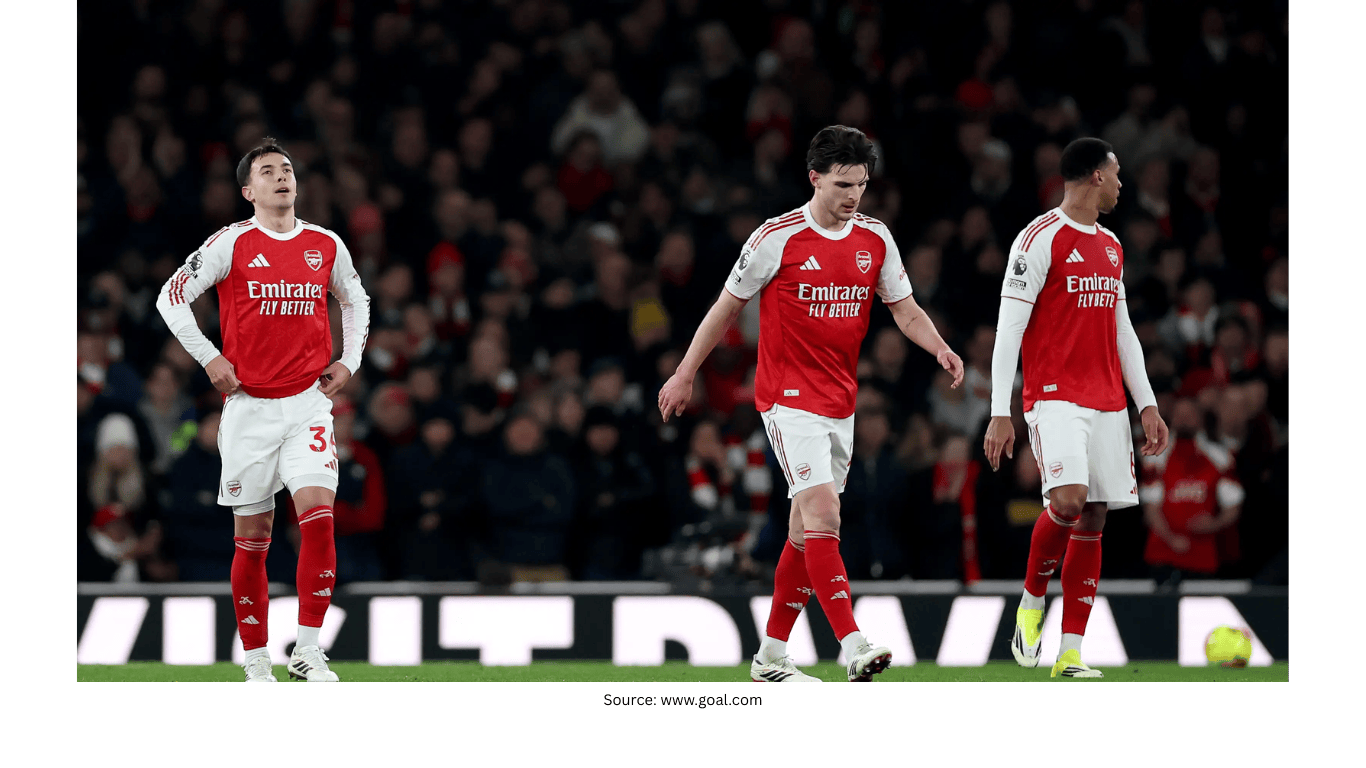
Arsenal’s lead cut as winless run continues
Arsenal’s position at the top of the Premier League has come under sharper scrutiny after a three-game winless run reduced their advantage to four points. The latest setback was a 3-2 home defeat to Manchester United, a result that left the league leaders facing renewed questions about how they handle pressure at the sharp end of the season.
While Arsenal remain in front, the margin has narrowed from seven points to four, and the manner of the defeat has become a central talking point. Former Arsenal captain Patrick Vieira was among those to publicly challenge the team’s mindset, suggesting that the title race will test more than just technical quality.
A dramatic late winner stuns the Emirates
The match itself delivered a late turning point. Matheus Cunha scored a sensational winner in the 87th minute to secure a 3-2 victory for Michael Carrick’s Manchester United. The late goal sealed a comeback-style finish and left Arsenal stunned at the Emirates Stadium.
For Arsenal, the defeat was not simply another dropped result; it added to a short run in which momentum has been harder to sustain. In a title race, those sequences can become defining, not only because of the points lost but because of the psychological impact they can have on a squad expected to set the pace.
Vieira: “There are still questions about the mental strength”
Vieira’s comments focused less on the fact of the defeat and more on its texture. He argued that Arsenal’s performance raised concerns about whether the team is consistently equipped to manage the demands of a title push, even with their current advantage still intact.
“They are still four points clear, but there are still questions about the mental strength of the team,” Vieira said. He added that the issue was “not just that they lost the game, it’s the way they lost the game.”
In Vieira’s view, key attacking players did not provide enough threat on the day. He singled out Bukayo Saka and Leandro Trossard, saying they “didn’t produce enough to worry United.” The criticism was pointed not at their overall ability, but at their impact in a match that carried significant weight for the league leaders.
Call for leadership and a return to basics
Vieira also framed the performance as one that lacked a guiding presence during difficult moments. “They need a leader to lift the spirit of the team,” he said, suggesting that Arsenal must find ways to respond when a match starts to drift away from them.
His assessment was that Arsenal did not play with the kind of energy and intent required in a game of that magnitude. Vieira argued the team must “play with more energy and more risks,” adding that the quality is there but that it must be expressed with greater freedom.
“They didn’t play with the freedom to express themselves,” he said, before returning to a familiar theme for teams navigating a tense run: fundamentals. “They need to go back to the basics,” Vieira added, calling for Arsenal to “express themselves, play with freedom, and go forward.”
He also described the match as one that carried a broader message. “It was a must-win game,” Vieira said, arguing Arsenal “needed to send a message to the rest of the teams in the league.”
Arteta responds: “We accept every opinion”
Arsenal manager Mikel Arteta was asked about Vieira’s remarks and did not dismiss them. Instead, he acknowledged the importance of demonstrating resilience in decisive moments, while also offering his own interpretation of what went wrong against United.
“That’s fine, we accept every opinion, where it comes and where it’s coming from and they will have the right reasons to say it,” Arteta said.
He agreed that the team must show mental strength to reach their targets, but he also pointed to performance levels, particularly in technical execution. “At the end we have to show the mental strength that we have on the pitch when it comes to a match day,” he said, before contrasting the United performance with a recent high point: “We were absolutely brilliant in Milan and today we weren’t that good.”
Arteta questioned whether the issue was purely psychological, suggesting that fatigue and technical errors may have played a significant role. “I don’t know if it was mental because of how much they played, but because we were poor, especially technically in certain aspects of the game against a team that, when you make those mistakes, they can punish you big time and that was the difference,” he said.
Keane: Arsenal looked fearful under pressure
Former midfielder Roy Keane offered a more blunt reading of Arsenal’s display, arguing that the team appeared weighed down by the occasion. For Keane, the context of the day mattered: Arsenal knew other results and understood what was at stake.
“Pressure was on Arsenal today. They saw the other results; they have everything going for them in all competitions. That is pressure; they are feeling the pressure,” Keane said.
He argued that the key question is how a team responds when the stakes rise. “It is how they deal with it,” he said, linking the latest defeat to a broader pattern in which Arsenal have, in his view, struggled to fully capitalise on strong positions in recent years.
Keane highlighted a loss of momentum across the last few weeks, referencing the Liverpool game, the Forest game and the United match as signs of a team that has not looked as confident as expected. “I can’t believe they don’t look like a confident team,” he said, suggesting Arsenal were “playing the occasion.”
His prescription echoed Vieira’s in one respect: simplify and meet the moment head-on. “They have to get back to basics and embrace this challenge instead of being frightened of it,” Keane said.
Neville: City will sense an opening
Gary Neville, speaking on his podcast, focused on what Arsenal’s wobble could mean for their closest challengers. With Arsenal’s lead now four points, Neville argued that Manchester City would be encouraged by the shift in the table and the signs of anxiety he believes have appeared in Arsenal’s recent performances.
When asked whether City would be getting excited about being four points back, Neville replied: “Just a bit.”
He framed the moment as one that demands a reset from Arsenal’s manager. “If you are Mikel Arteta, I was wondering what you do in the morning to reset,” Neville said, before describing how he believes Pep Guardiola would address his own squad in the same situation.
Neville suggested Guardiola would use Arsenal’s recent displays as motivation, imagining a message along the lines of: “Are you really going to let these off the hook? They were nervous, they were anxious.”
From Neville’s perspective, the opportunity for City is not only about the points gap but about applying sustained pressure over time. He described a scenario in which City aim to move within touching distance and test Arsenal’s response as the season progresses.
“Four points. Let’s get them into March and April, let’s get on their shoulder, let’s see what they are about,” Neville said, adding that this is what he would expect Guardiola to communicate: “Hang on the shoulder of this team and let’s see what they are about.”
What the criticism centres on
Taken together, the commentary from Vieira, Arteta, Keane and Neville circles around a few connected themes: performance under pressure, leadership during difficult spells, and the balance between technical execution and mentality in decisive matches.
Mindset in key moments: Vieira’s central point was that Arsenal’s mental strength remains open to question, particularly in how they lose games rather than simply the fact they lose them.
Attacking impact: Vieira argued that Saka and Trossard did not do enough to trouble United, a critique tied to Arsenal’s need to play with freedom and intent.
Leadership and energy: Vieira called for a leader to lift the group’s spirit and urged more energy and risk-taking.
Technical standards: Arteta pointed to technical mistakes and the danger of facing an opponent capable of punishing errors.
Handling the occasion: Keane described Arsenal as fearful and argued they must embrace the challenge rather than be intimidated by it.
Rivals sensing vulnerability: Neville’s focus was on how Manchester City might respond, framing Arsenal’s stutter as an invitation for challengers to apply pressure.
A title race that now demands a response
Arsenal’s advantage at the top of the Premier League remains in their hands, but the margin for error has narrowed. A three-game winless run and a home defeat decided by a late winner have intensified the spotlight on how the team responds when matches become tense and unpredictable.
Vieira’s critique, Keane’s warnings and Neville’s projection of how rivals may react all point to the same reality: the next phase of the season will not only measure Arsenal’s quality, but also their composure and consistency on match days. Arteta, for his part, has accepted the scrutiny and underlined that the team must show mental strength while also raising their technical level to avoid being punished.
With a four-point lead still intact, Arsenal have room to steady themselves. But the conversation around them has shifted from whether they can lead the table to whether they can sustain it when pressure rises and challengers sense an opening.