
Madrid Celebrate Valentine’s Night With Big Home Win Over Real Sociedad
A Valentine’s night that felt like a reunion
On a night framed as a “Happy Valentine’s” for the home crowd, Madrid delivered the kind of emphatic Bernabéu performance that can change the mood around a season. Arbeloa’s team, playing without Mbappé, produced a convincing scoreline against Real Sociedad, combining sharp finishing with moments of individual quality to claim a 4–1 victory. The result extended Madrid’s league run to eight consecutive wins and, at least for the next 48 hours, placed them at the top of the table.
The story of the match was not simply the margin of victory, but the way it arrived: Madrid were more clinical than creative, yet still walked away with a haul of goals and a list of encouraging signs. Vinicius was central to the outcome, winning two penalties and converting both. Gonzalo again showed that, in this particular setup, there is “life without Mbappé,” and Trent’s passing offered a glimpse of why he is valued as a top-class distributor. The Bernabéu, so often a barometer of confidence and doubt, ended the evening on the side of celebration.
Two teams arriving from opposite directions
The context around the fixture mattered. Real Sociedad arrived after a crucial Copa match at San Mamés, a game that carried the natural consequence of fatigue and rotation. Matarazzo changed four players at the Bernabéu, a moderate reshuffle that still kept most of his key figures involved. Even so, the visitors looked diminished, with the lingering effects of their recent demands visible in both phases of play.
Madrid, by contrast, were looking ahead as much as they were looking at the present. The match came “on the way” to Lisbon, a destination described as a kind of penance after a painful night there a little more than two weeks earlier. With that in mind, Arbeloa chose to rest Mbappé—credited here as the holder of 38 goals—because he is considered essential for the upcoming task at Da Luz. It was a decision that carried risk: the record noted that in the four league matches in which the Frenchman had not scored, Madrid had only won one of them.
Yet football often moves along alternative routes. Madrid’s path in this match suggested a team trying to let results pull the performance forward, rather than waiting for perfect play before collecting points. It is not always pretty, but it can be effective.
Gonzalo strikes early, and Trent’s passing stands out
The opening minutes quickly challenged the assumption that Madrid would struggle without Mbappé. Gonzalo needed only four minutes to put the home side ahead, applying what was described as the “manual of the number nine.” The move began with a Trent pass—an early reminder that his greatest virtue, at least in this account, is what he offers with the ball. Gonzalo’s run and finish were a blend of instinct and intelligence: a subtle touch, almost a toe-poke, that opened the angle just enough for the ball to drift into the net.
The goal also revealed a tactical idea. Real Sociedad’s tendency to defend aggressively and step forward left space behind them when they had to retreat. Madrid leaned into that weakness by playing longer balls into the open areas. With Camavinga acting as a launcher, the home side looked for Gonzalo repeatedly. One chance slipped away when Gonzalo switched feet at the wrong moment—an example of how, inside the penalty area, extra steps can turn clarity into complication.
A penalty at each end, and a match of defensive errors
Madrid’s early advantage did not bring control. It evaporated due to a costly defensive mistake from Huijsen, described as still a young defender learning his trade. Yangel Herrera burst into the area “like a knife,” and the centre-back brought him down when the safer choice would have been to block the shot. The incident led to a penalty and an equaliser: Oyarzabal made it 1–1 in the 20th minute.
The Bernabéu reaction captured the tension of a season in which the crowd can swing from whistles to encouragement within the same minute. The uncertainty in the stands mirrored the uncertainty on the pitch, as the game began to feel like a contest between errors as much as a contest between ideas.
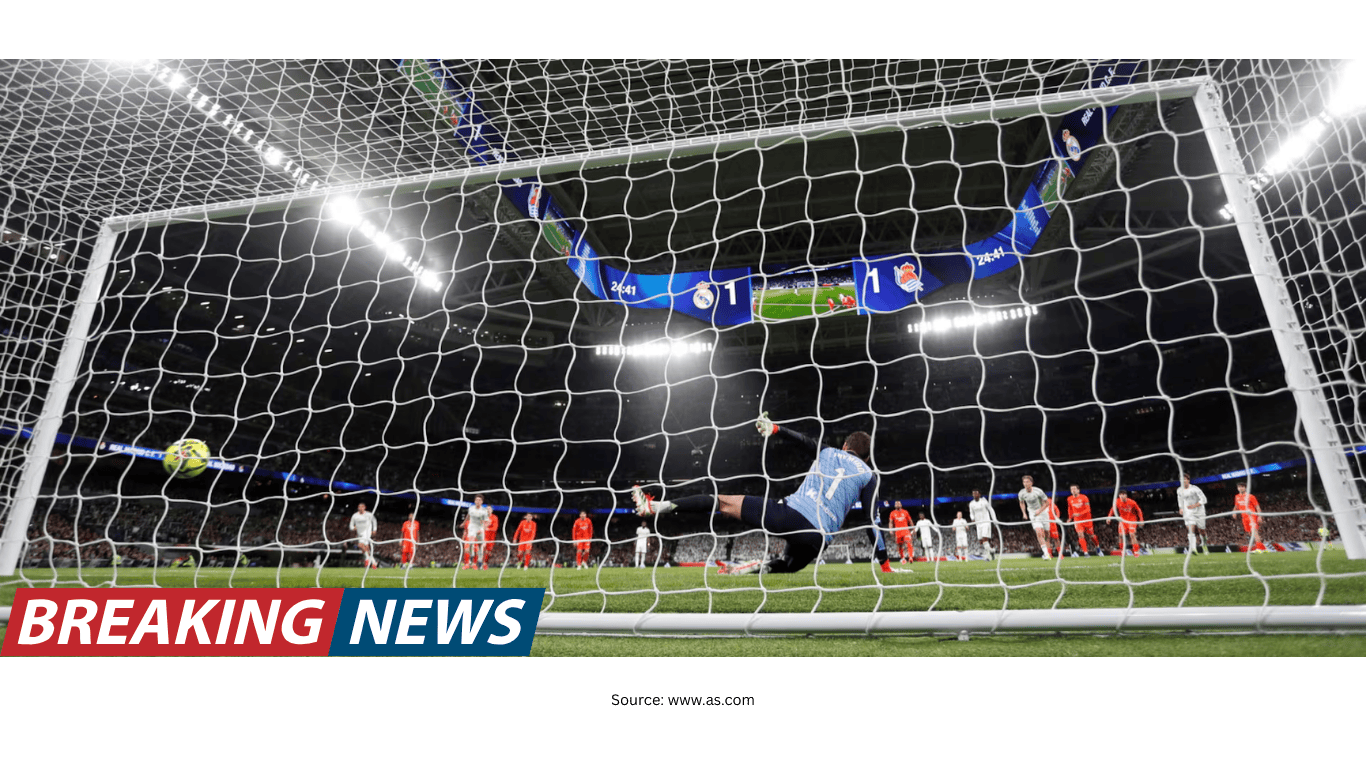
Real Sociedad soon offered their own moment of inexperience. Aramburu was beaten by a Vinicius feint and left a trailing foot in the area. Vinicius made sure the contact was seen, and while the penalty was portrayed as more debatable than the earlier one, it still stood. Vinicius then converted from the spot to restore Madrid’s lead at 2–1 in the 24th minute.
That sequence made Vinicius both the cause and the consequence of the goal: he created the danger, forced the mistake, and delivered the finish. For long stretches, he also looked like a player reminding everyone that he once played like a magician—and that he may be on the way back to that level.
Valverde adds a third as goals outpace the flow of play
Despite the growing scoreline, the match was not described as high in rhythm or clear domination. Real Sociedad had more of the ball “on points,” while Madrid matched them in chances by a similar margin. What tilted the night decisively was that the goals kept arriving in a game where both defences appeared unusually transparent.
The third goal, scored by Valverde in the 30th minute, reflected that defensive fragility. Real Sociedad allowed him to control the ball on the edge of the box and pick out the top corner without meaningful pressure. It was a high-quality finish, but also an illustration of how comfortably Madrid were being allowed to shoot from dangerous positions.
By half-time, Madrid had scored three, and even had a chance for a fourth through Gonzalo that did not go in. The assessment was blunt: the performance did not fully justify the number of goals, but few at the stadium would have complained.
Vinicius seals it quickly after the break
Any faint hope of a comeback was extinguished almost immediately after the interval. Vinicius, operating near the byline, produced a brilliant manoeuvre to create separation. Aramburu, who had already struggled to contain him, lost track again and brought him down for a second time. The referee pointed to the spot once more.
Vinicius converted again, completing a personal double via penalties and taking the match to 4–1 in the 47th minute. With that, the contest’s emotional edge largely disappeared, even if the flow of chances did not.
Chances continue, substitutions follow, and the stadium settles
With the result effectively decided, the match opened up rather than closing down. Chances arrived in volume at both ends, attributed to a general relaxation across the pitch. Gonzalo had two more opportunities, while Valverde, Jon Martín, Aihen Muñoz, Vinicius and Güler were also mentioned among those involved in further openings.
Arbeloa then used the comfort of the scoreline to introduce players who had been managed carefully. Carvajal and Alaba came on, described as having been treated like convalescents until now. The game state did not allow for a full evaluation of their condition, but Carvajal did contribute a significant defensive action, intercepting a Guedes shot in front of a crowd that by then was fully on board.
By the final whistle, the sense was that Madrid’s “reconciliation” with the Bernabéu—always an unstable relationship, subject to mood and momentum—looked real again, at least for this night.
What the result suggested about Madrid
Beyond the goals, the match was framed as a collection of positive indicators for Madrid, even if the overall play was not portrayed as complete. Among the notable points raised:
Trent’s influence with the ball: He was described as a first-class passer, and his assist for Gonzalo underlined that quality. Valverde’s work was noted as helping cover defensive shortcomings.
Gonzalo’s effectiveness without Mbappé: The narrative stressed that Gonzalo’s scoring output rises when the French star is absent, and his early goal reinforced that theme—though with the caveat that it may not happen every day.
Rüdiger’s importance to the defensive picture: He was portrayed as someone who can “reforest” the defence, with the upcoming Benfica match in mind.
Vinicius’ return to impact: Winning and scoring two penalties, he looked closer to his most decisive version, offering the threat of sustaining that level rather than appearing only in flashes.
At the same time, the match did not hide the vulnerabilities. Madrid conceded from a penalty caused by a rash challenge, and the overall description of the game included a sense that goals were doing more of the explaining than the football itself.
Real Sociedad’s night: too little at both ends
For Real Sociedad, the defeat was depicted as a continuation of a difficult period, with the heavy match at Bilbao having taken a visible toll. The analysis was unsparing: they neither defended nor attacked effectively, and those two “nots” tend to lead inevitably to defeat. Even if the team had more of the ball in phases, they were repeatedly exposed in transition and too permissive around their own box.
The penalty conceded by Aramburu in the first half was presented as avoidable, and the second after the break was even more damaging, turning an already uphill task into a near impossibility. Madrid’s ability to exploit space behind the visitors’ forward-leaning defensive posture became a recurring theme, and once the scoreline stretched, the match became a test of resistance rather than a contest of equals.
Match details
Score: Madrid 4–1 Real Sociedad
Goals: 1–0 (4’) Gonzalo; 1–1 (20’) Oyarzabal; 2–1 (24’) Vinicius Junior (pen.); 3–1 (30’) Federico Valverde; 4–1 (47’) Vinicius Junior (pen.)
Referee: Francisco José Hernández Maeso
VAR: Daniel Jesús Trujillo Suárez, Javier Iglesias Villanueva
Cards noted: Dean Huijsen (19’); Beñat Turrientes (91’)
Substitutions noted
Gonçalo Guedes (45’, Wesley)
Dani Carvajal (59’, Trent Alexander-Arnold)
Beñat Turrientes (59’, Yangel Herrera)
David Alaba (59’, Antonio Rüdiger)
Orri Óskarsson (59’, Mikel Oyarzabal)
Daniel Díaz (72’, Pablo Marín)
Brahim Díaz (72’, Federico Valverde)
Dani Ceballos (72’, Eduardo Camavinga)
Jorge Cestero (78’, Aurélien Tchouaméni)
A win built on finishing, and a platform for what comes next
Madrid’s latest league victory followed a familiar logic: win first, then refine. The performance was not portrayed as flawless, and the match contained enough defensive looseness to keep the coaching staff cautious. But the essentials were there—goals, momentum, and a home crowd that ended the night feeling connected to the team again.
In a season where confidence can look fragile, a 4–1 win against Real Sociedad, achieved without Mbappé and powered by Vinicius’ decisive interventions, offered a clear statement. Madrid left the Bernabéu with another victory in the bank, a temporary hold on first place, and a sense that their alternative route toward stability is still open.